Car Charger Stability During Engine Start: A Buyer Checklist
Why can car charging stop when the engine starts? Learn what importers should verify for 12V/24V USB car chargers before ordering.
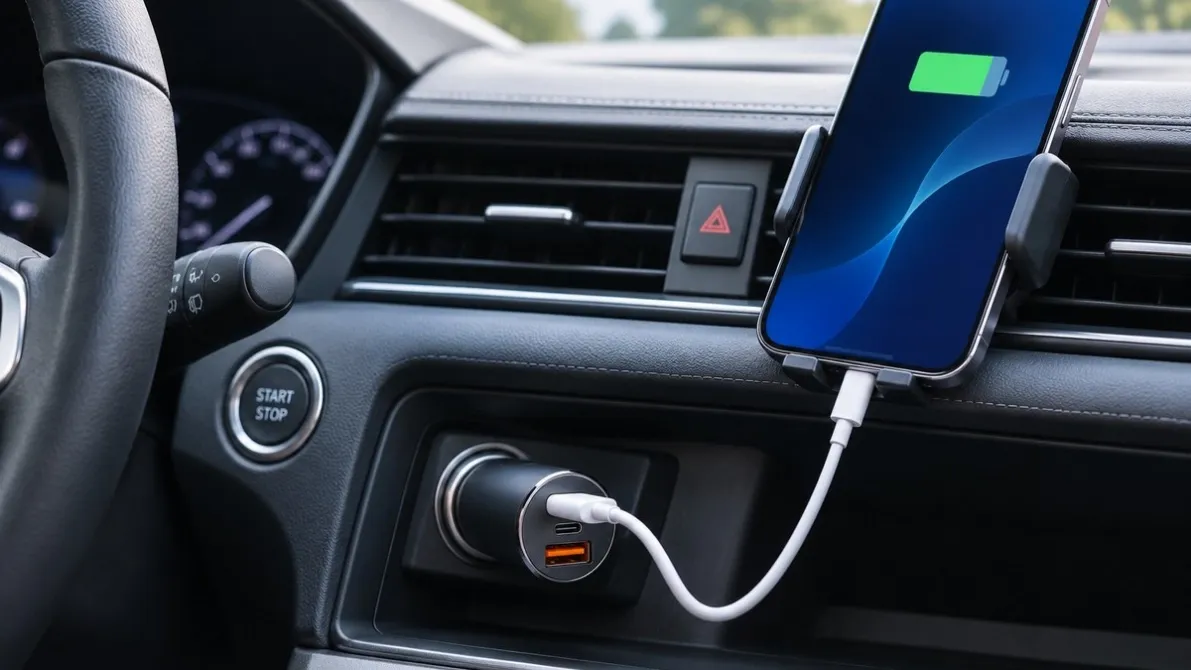
How to check 12V/24V input, charging continuity and vehicle conditions before bulk orders.
A car charger may work perfectly on a stable bench supply yet behave differently inside a moving vehicle. If a customer reports that charging restarts when the engine starts, the cause may be a temporary change in vehicle supply voltage—not necessarily a faulty USB cable.
For importers, the useful question is: was the charger evaluated under the vehicle conditions promised on its packaging?
Why Vehicle Power Is Different
Cars do not provide a perfectly constant DC supply. During engine cranking and automatic stop-start operation, input voltage can fall temporarily. Automotive electronics also need to account for electrical transients and the operating conditions of the vehicle.
Analog Devices describes these challenges in its technical article on automotive USB charger design. The article concerns engineering principles; it is not a test report for any particular Lirui product.
A charger advertised for both passenger cars and 24V commercial vehicles should be checked against its approved input-voltage specification and appropriate application tests.
Five Checks Before Approving Samples
1. Confirm the input range. The printed 12–24V DC input rating must match the actual approved model and test conditions.
2. Check startup behavior. Observe whether the charger recovers correctly after the input supply changes. Document whether connected devices reconnect or lose charging.
3. Test individual and combined ports. Verify the advertised output for USB-C and USB-A separately, then under simultaneous loading.
4. Check contact fit. Try the approved sample in representative vehicle sockets. Loose contact can resemble an electrical fault.
5. Review sustained operation. Evaluate temperature and output stability under specified loads, using suitable equipment and qualified technicians.
Do not improvise electrical transient tests on an occupied road vehicle. Ask the supplier to document the test method and acceptance limits.
What to Include in the Purchase Order
Record the vehicle input range, USB output profiles, approved appearance, operating test conditions, packaging claims and sample reference. Specify whether a brief interruption during ignition cycling is acceptable to your customer; do not assume every car or phone behaves identically.
Lirui lists a 38W USB-C + USB-A car charger with 12–24V DC input and a combined 20W + 18W output. Those figures are from the product listing, not newly independently verified test results.
Buyer Takeaway
A wattage number alone does not show how a car charger behaves during engine start. Agree on realistic input and load testing before bulk production to make complaints easier to investigate.
Related product: 38W PD QC3.0 Car Charger
For samples and OEM orders, kindly contact us.
References & Sources
- Analog Devices — Understanding Challenges in USB Charger Design for Automotive Applications (engineering article). https://www.analog.com/en/resources/technical-articles/understanding-challenges-in-usb-charger-design-for-automotive-applications.html
- Lirui Electronics — Wholesale 38W PD QC3.0 Car Charger with Digital Voltage Display (product specification). https://www.liruitech.com/products/wholesale-38w-pd-qc3-0-car-charger-with-digital-voltage-display